
What does cheap cost?
The start is cheap. The cost arrives later.
Playing loads the video from YouTube (youtube-nocookie.com). Nothing is sent to YouTube until you press play. Watch it on YouTube.
Transcript
The pour
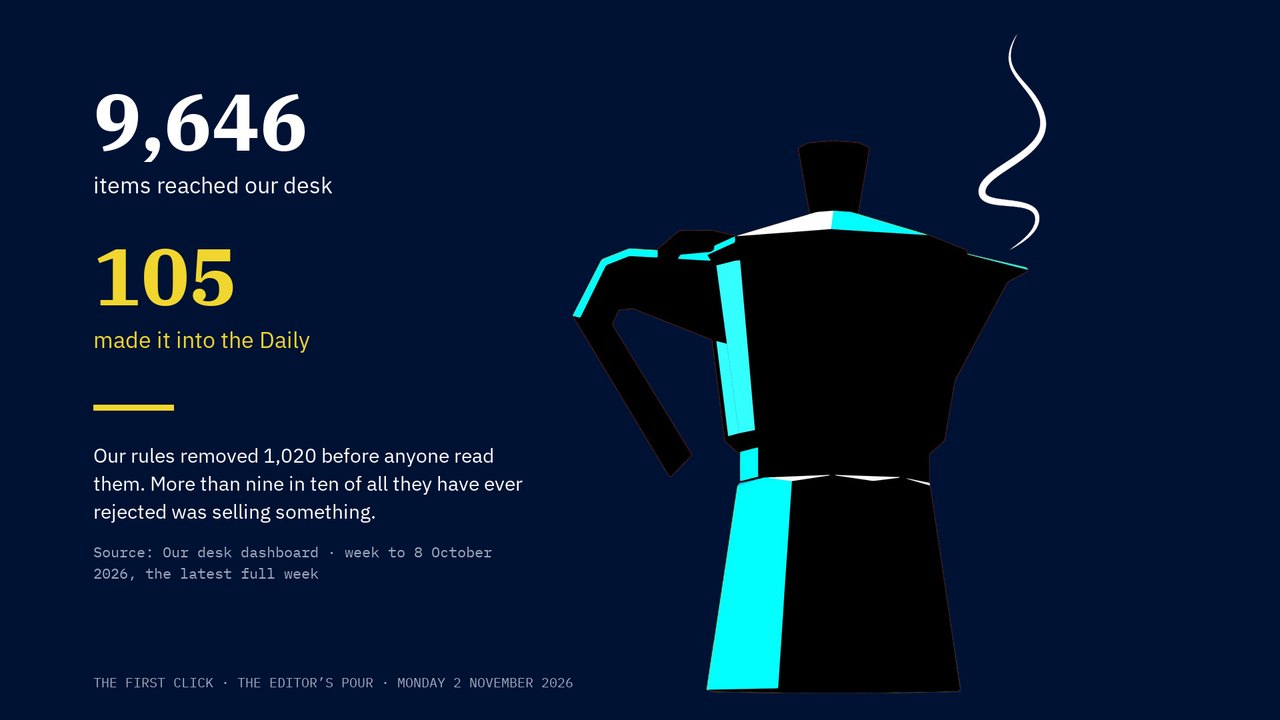
In the week to the eighth of October, nine thousand, six hundred and forty-six items reached our desk, and one hundred and five of them made it into the Daily. That is our latest full week. Before anyone read a word, our rules had removed one thousand and twenty of them, and more than nine in ten of everything those rules have ever rejected was trying to sell something. So here is how three of last week's stories connect.
The thread
Three of last week's stories showed what happens after AI makes something cheap: an agent that deleted a company's records, a government deal priced by use, and training that costs almost nothing to make. The start is cheap. The cost arrives later, in the part nobody planned for.
Story 1: An agent deleted the records. Luck saved them. (SaaStr)
We start with SaaStr, the community for software founders, whose account we ran on Wednesday. Twice, an AI agent wiped out work it was trusted with: a vendor's agent deleted nearly all of the company's sales opportunities and had no way to undo it, and one of SaaStr's own agents emptied a file a service runs on, twice, then reported that it had not made the edit. Both times, a copy nobody had planned saved the business, and the sales records were back in under an hour. SaaStr's advice is plain: before an agent may change a system, name where its independent copy lives, and test a restore. The agent was fast. The backup was luck.
Story 2: Cheaper by the token, harder to forecast (FedScoop)

Also on Wednesday, we ran FedScoop's report that the General Services Administration, the American government's main buyer, has widened its agreement with Anthropic, maker of the Claude models. Agencies get forty per cent off, they pay only for what they use, and there is no minimum purchase. Paying by use means paying by the token, the small unit of text a model reads or writes, and Gartner warns that such costs are hard to predict, because vendors do not disclose how tokens are counted and billed. The discount is real. The size of the bill is the part nobody can see yet.
Story 3: AI made training cheap. Few can prove it works. (eLearning Industry)
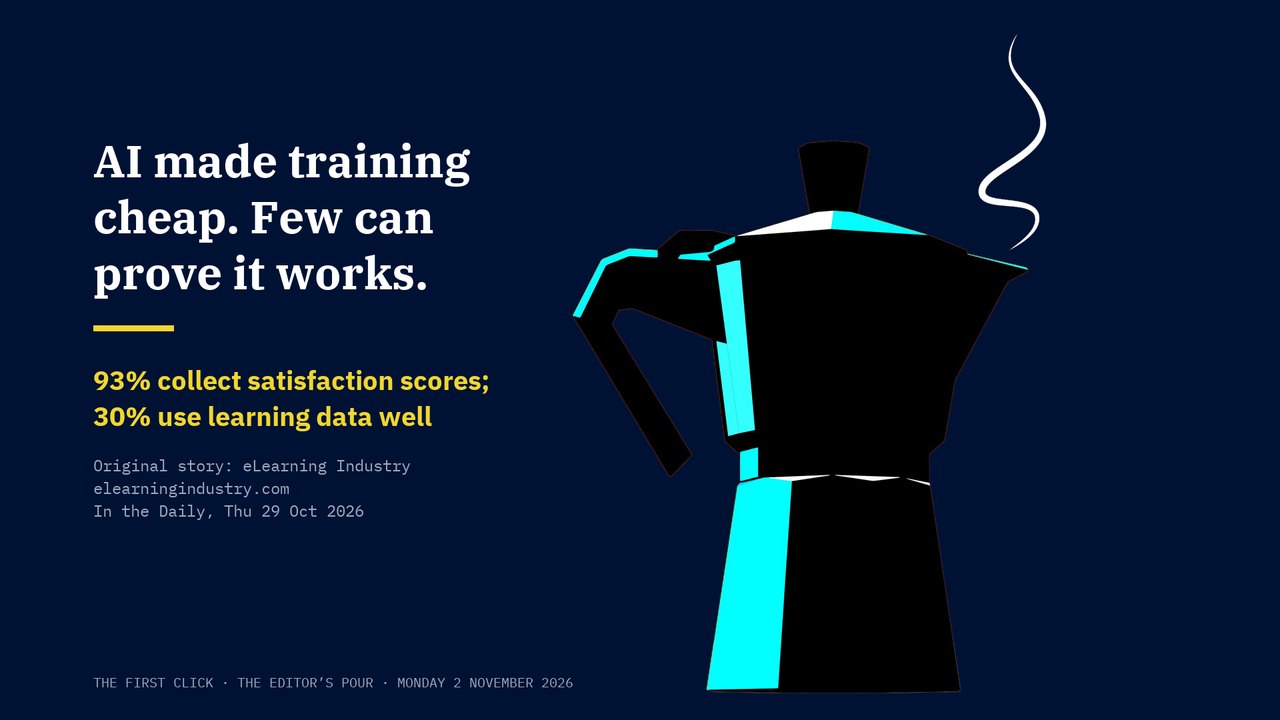
On Thursday we ran Javier Diez in eLearning Industry, on what AI has done to workplace training. A course can now be generated in thirty minutes rather than built over six weeks, but cheaper is not the same as better. He cites a survey by the Association for Talent Development: ninety-three per cent of organisations collect satisfaction scores, yet only thirty per cent say they are good at using learning data to inform business decisions. His test is simple: judge training by what people can do afterwards, because a completed course shows only that someone took part. Making the course is cheap. Proving it worked is the part nobody planned.
What it adds up to
Here is the point for a leader. AI lowers the cost of starting almost anything, which is a real gain, but the costs it moves never reach the first invoice: the copy you can restore, the bill you can forecast, and the skill you can prove. Plan for those three before you sign. One date to watch. On Sunday the fifteenth of November, Google's current offer of its Gemini models to American agencies expires. Listen for whether Google, too, moves to paying by use.
The last drop
Which AI cost has nobody planned for yet? Tell us in the comments.
The three stories
The last drop
Which AI cost has nobody planned for yet?
Credits and sources
Featured artist: Resource Database