
When the Sun Logs Us Out
A friend recently sent me a report from a Chinese city where an atmospheric anomaly blocked GPS signals and brought the transport system to a halt. No missiles, no hackers, no cyber-warfare unit. Just the sky, briefly, refusing to cooperate.

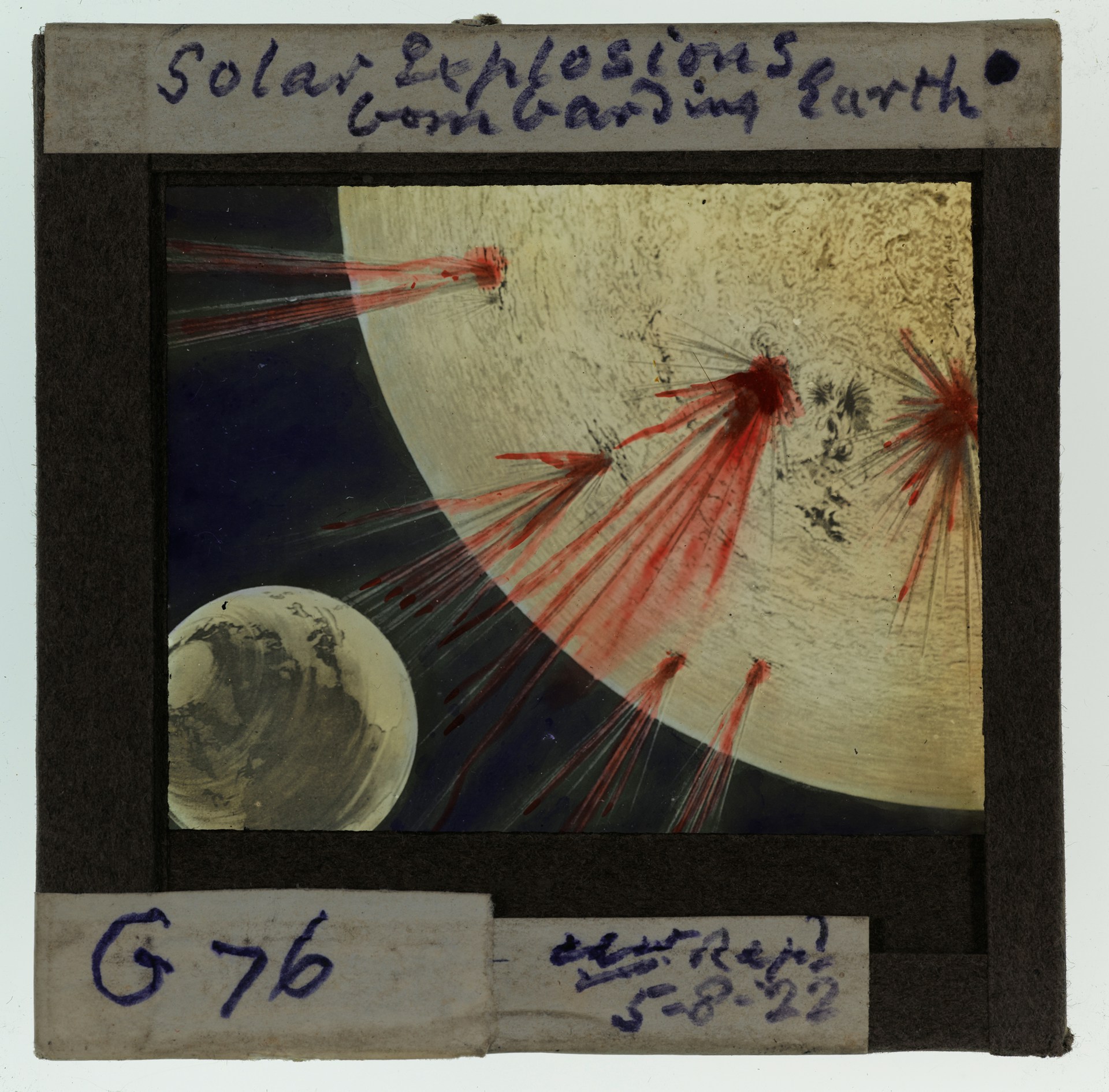
Here is my uncomfortable thesis: it would take a solar storm lasting about six hours to bring most of modern human life to a standstill. Not the aircraft. Not the power stations. Us. The eight billion people who have wrapped their days so tightly around a stack of satellite-dependent conveniences that we have forgotten what "ordinary" looked like before them.
The Sun has done this before
This is not science fiction. It is a pattern with a 170-year paper trail.
On 1 September 1859, an English astronomer named Richard Carrington was sketching sunspots when a blinding white flash erupted across his projection screen. Seventeen hours later, the Sun's ejected plasma slammed into Earth. Auroras were seen in Cuba, Hawaii and Colombia. The telegraph, the only electrical infrastructure on the planet, went haywire: wires sparked, operators were shocked, paper caught fire, and some lines kept transmitting with their batteries disconnected, powered by nothing but the current the sky was inducing in them. The Carrington Event remains the yardstick for an extreme storm.
It was not a one-off. In February 1872 a storm of similar size lit up the night over Bombay. Yes, Bombay. Northern lights over the Arabian Sea, recorded also at Aden and Khartoum, while telegraph traffic across India and the Mediterranean stalled for hours. Another followed in 1882, silencing the telegraph and the first telephone exchanges. Three Carrington-class storms in one century, in a world that had exactly one thing to break.
Then the world acquired more things. In May 1921 a storm set fire to railway signalling and telegraph equipment on both sides of the Atlantic. In March 1989 a storm collapsed Hydro-Québec's grid in ninety seconds and left six million people in the dark in a Canadian winter. In July 2012 a Carrington-scale eruption missed Earth by roughly a week of orbital position; studies of what it would have done had it hit run into the trillions of dollars and months of recovery. In February 2022 a mild storm puffed up the upper atmosphere just enough to drag some forty freshly launched Starlink satellites down to burn. In May 2024, the strongest storm in two decades degraded GPS precision so badly that farmers in the American Midwest had to park their auto-steering tractors in the middle of planting season.
And now the last twelve months. In November 2025 and again in January 2026, two storms came within a hair of the extreme category. The January eruption crossed from Sun to Earth in about 25 hours, uncomfortably close to Carrington's 17. The November storm produced radio blackouts across Europe and Africa and, according to research published this month, scrambled GPS coast to coast across the United States, in places that had never recorded such disruption, with positioning errors of more than ten metres. The power grid held. The planes flew. The layer that wobbled was the invisible one: positioning, timing, radio.
Notice the pattern. The Sun has not changed since 1859. What has changed is the surface area we present to it. The damage keeps migrating upward, away from steel and copper and toward the thin layer of satellite signals that everything now quietly depends on.
Planes will not fall from the sky
Let me deal with the Hollywood fear first, because it is the least interesting part of the story.
Aviation is old, paranoid and built by people who assumed things would break. Ground-based radio beacons, instrument landing systems, VHF voice communication: much of this is 1950s technology, and that is precisely why it will still work. If satellite navigation degrades, controllers fall back to procedures they train for, spacing widens, polar routes get rerouted, and traffic resumes within the hour. Those old beacons can be pushed well beyond their normal operating envelope if needed. The flight will be late. It will not be tragic.
The same is broadly true of the power grid, at least in countries that took 1989 seriously and hardened their transformers. Hospitals have generators. Banks have mainframes. The core of civilisation is more robust than the doomsayers claim.
The fragile layer is the one we love most
The pain will come from a different direction entirely: from the consumer-tech layer that sits on top of everything, has no fallback, and has eaten our habits whole. And it will look different in every country, which is the point. Nobody is exempt.
Picture the same six hours playing out across the world.
In San Francisco, Phoenix, Wuhan and Beijing, the robotaxis stop. Waymo, Tesla, Baidu's Apollo Go, Pony.ai: every driverless car on the road is fusing satellite positioning with its cameras and lidar, and when the satellite half of that equation starts lying by ten metres, the safety software does exactly what it was designed to do. It pulls over and waits. Thousands of empty cars, parked at odd angles across two of the world's largest economies, waiting for a sky that will not clear for hours. The human driver they were built to replace is, in that moment, the one thing they lack.
In Mumbai, Delhi and Bengaluru, Zomato and Swiggy do not deliver, because a rider without live location is invisible to the app that pays him. In Jakarta and Manila, Grab and Gojek go dark for the same reason; in Shanghai it is Meituan and Ele.me; in London and Berlin, Deliveroo and Uber Eats. Ride-hailing collapses everywhere at once: Uber, Lyft, Didi, Ola, Bolt. Amazon's last-mile vans, which navigate on turn-by-turn instructions rather than on drivers who know the streets, sit idle in depots.
Then the money. Digital payments begin to fail, not because the funds have vanished but because the timing signals that keep servers, ATMs and mobile towers in sync ride on the same satellites. In India, where a billion people pay with UPI and where welfare rations are released only after a biometric scan verifies over a network, that is not an inconvenience; it is a missed meal. In China, where cash has all but disappeared and WeChat Pay and Alipay are the economy, it is a nation that cannot buy lunch. In Kenya, M-Pesa. In Sweden, Swish. The places that most proudly went cashless are the places with the least to fall back on.
And beneath all of it, the workers. Tens of millions of gig drivers and riders across the planet, none of whom draw a salary, lose a day's income in the same six hours. The world's most flexible workforce turns out to be its most fragile.
None of these are life-support systems. All of them are now load-bearing for daily life. That is the trap. We did not build redundancy into the food-delivery economy or the robotaxi fleet because nobody thought of them as infrastructure. They became infrastructure anyway.
No 5G will hurt more than no runway lights
This is the inversion I want people to sit with. If you asked the average person which would cause more human suffering, losing airport radar or losing mobile data, they would say the radar. They would be wrong. The radar has a backup. The phone in your pocket is the backup for nothing and is relied upon for everything.
And the tower of pure attention, the TikToks and reels and infinite feeds, will be the first to fall, because it is the least essential and the most dependent on a flawless, always-on network. There is something almost poetic in that. The most fragile thing we have built is also the thing we spend the most hours holding.
Do not dismantle the old radio
The same friend made a plea I want to amplify: whatever else we modernise, let us not switch off shortwave and medium wave radio.
Broadcasters from the BBC to Deutsche Welle to Radio Canada have been quietly shutting down these transmitters for a decade, calling them relics. They are relics. That is the point. A medium wave signal needs no satellite, no data centre, no login and no subscription. A receiver can be built from a handful of components and run on a battery for weeks. When every other channel is down, whether from a solar storm, a grid failure or some future cataclysm of our own making, the crackling voice on a cheap transistor radio is the one that still reaches the village, the farm, the fishing boat. It is the last communication medium standing, and we are dismantling it to save the electricity bill.
I will admit some personal bias here, earned the hard way. A few years ago the Vishwamitri river burst its banks in Baroda, in western India, and cut the city in two on the day my mother's train was due. Every 4G network in the city was dead. My phone, the one people tease me about, was sitting on 2G, and 2G was alive. I called the station master, asked him to find one passenger on one platform and tell her to stay on the train to the next city, Bharuch. Then I drove forty-five minutes flat out and was standing there when she stepped off. A network that works badly everywhere turned out to be more useful in a crisis than one that works brilliantly until it does not. There is a lesson in that for every country racing to switch off its 2G and 3G towers: the resilient option rarely looks like the impressive one.
The same logic applies to the humble cable. The internet does not, in fact, live in the sky; the overwhelming majority of it travels through glass fibre buried in the ground and laid across ocean floors, and glass does not care about geomagnetic storms. What does care is the electricity that powers the repeaters along a transoceanic cable and the routers at either end. Protect those, and the wired internet survives a storm that takes the satellites down. It is the mobile last mile, the tower on the roof and the signal to your pocket, that fails first. Which is why I have never unplugged the dumb little desktop switch under my table. My LAN-gaming days are long behind me, but a cable that goes straight into a router asks nothing of the sky, and a household where at least one computer is still on Ethernet is a household that stays online when the Wi-Fi mesh and the 5G router are both blinking uselessly. Keep the cable. Keep the port. Do not let the laptop makers talk you out of it.
How likely, and when
Two questions get tangled here, so let me separate them.
The first is the solar cycle. The Sun runs on an eleven-year rhythm, and the current cycle, Cycle 25, was forecast to be feeble. It was not. Sunspot counts peaked in the second half of 2024 at nearly double what forecasters expected, and we are now on the downslope. That sounds reassuring until you learn that the downslope is where the Sun keeps its worst tantrums: the previous cycle peaked in 2014, and its two largest flares arrived in 2017. Expect strong storms through 2027 and 2028. The next maximum, Cycle 26, is due somewhere around 2035 to 2037, though the people who guessed wrong about this one are, sensibly, hedging.
The second question is the one that matters: when does the next Carrington come? Nobody can date it. What scientists can do is estimate the odds, and the estimates run from roughly one or two percent per decade at the conservative end to around ten or twelve percent per decade at the other. Take the middle of that range and the chance of a Carrington-class hit within a working lifetime is somewhere between a bad bet and a coin toss. The 2012 near-miss was not a fluke; it was the dice landing one notch away.
And when it does come, the warning will be short. A large eruption is visible on the Sun within minutes, but whether it will actually strike Earth, and how hard, is only confirmed when the plasma passes the sentinel spacecraft parked a million miles upstream. That gives forecasters, and everyone downstream of them, somewhere between fifteen and sixty minutes of certainty. Enough to safe a satellite. Not enough to rebuild a food-delivery economy, or recall a robotaxi fleet, that never planned for the sky to fail.
What would actually help
I am not asking anyone to give up their apps. I am asking us to stop pretending the sky is a utility that cannot fail.
Four modest things. First, every government should treat satellite timing the way it treats electricity: regulate it, back it up with ground-based alternatives, and stop letting critical services assume it is free and permanent. Second, require the platforms that now function as infrastructure, from delivery apps to driverless fleets to payment networks, to have a degraded mode: a way to keep working slowly rather than not at all. Third, keep at least a skeleton of terrestrial broadcast alive, medium wave included, as a national emergency channel, and stop treating it as a line item to be cut. Fourth, and most cheaply, teach people what a solar storm is, and what a basic survival kit looks like. Not a bunker. A drawer. A battery radio. Spare batteries, checked twice a year, and a flashlight that does not need charging. Candles and matches, because there is nothing wrong with the eleventh century when the twenty-first is offline. A way to filter water that does not plug into a wall. Cash. A paper map. A phone, or a SIM, that still falls back to an older network. And the one thing my Baroda evening taught me: at least one way to reach the people you love that does not route through an app. The kit is not about the disaster. It is about having a backup, so that when the screens go dark, the first response is not panic but a shrug and a walk to the nearest shop.
The Sun will do this again. That part is not in doubt; the only question is the date. Whether it costs us six hours or six weeks depends entirely on how honestly we look at the difference between the technology that keeps us alive and the technology that keeps us entertained.
Planes will keep flying. Whether dinner arrives, or the taxi comes, is another matter.