
Marketing & Design
Brand, creative, martech and the consumer, read for the decisions behind the work rather than the work alone.
Marketing and Design covers the work of making people want things, and the decisions that sit behind it. Three stories a weekday at 11: a rebrand and what it risks, a visual system and why it was built, a consumer shift and what it costs to ignore. The beats are brand strategy, creative and design, martech, and consumer insights, with a Funny lane for the campaigns that made us laugh, on purpose or otherwise. We write every summary ourselves and link to the publisher, because the reporting is theirs. What is ours is the choice, and the editor’s note under the day’s lead says why it was made. Readers here run marketing functions, design teams and agencies in India, the United States and the United Kingdom, and the stories are chosen for what travels between those markets.
Every story we have kept in Marketing & Design, newest first. Headlines link to the publisher; the tags below narrow the list.
For the Designless, The death of the deliverable, iPhone Duo’s UX
A design-industry newsletter examines AI's effect on who can access design work, argues traditional deliverables like wireframes misunderstand design's real purpose, and critiques Apple's iPhone Duo for stretching apps rather than redesigning them.
Editor's noteThe argument that wireframes miss the point lands harder now that anyone can generate one. If the deliverable was never the value, the profession's defence cannot be craft alone. Watch whether design teams start being measured on decisions made rather than artefacts shipped, because that shift changes hiring before it changes tools.
Nothing has changed other than how we talk about it
An essay arguing AI agents do not replace design discovery but remove the excuses to skip it, describing agentic workflows that draft requirements while keeping human approval mandatory.
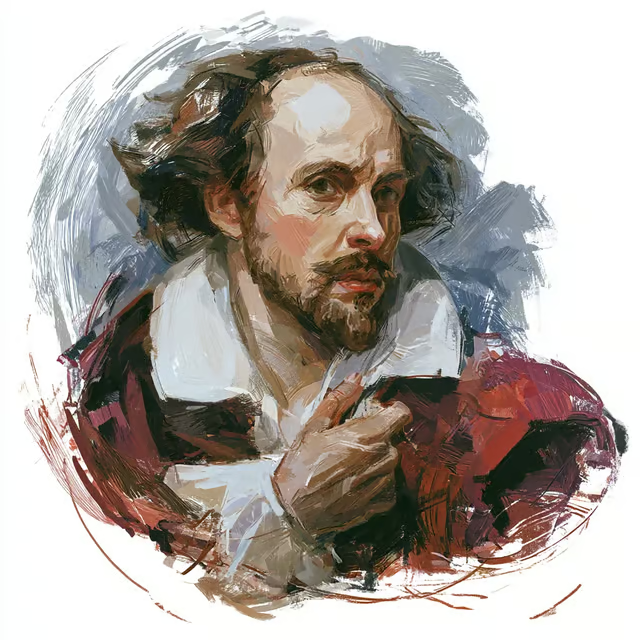
What Shakespeare got right about AI
AI’s greatest risks often arise from human interpretation, overconfidence, and wishful thinking, comparing chatbot outputs to prophecies that can be technically correct yet misleading.
Editor's noteWe chose this as the lead story because it explores a challenge every designer, marketer, and product builder now faces: understanding AI is as much about human behavior as technology. By drawing parallels between Shakespeare’s prophecies and modern AI outputs, the article offers a memorable framework for thinking about trust, interpretation, and decision-making in an AI-driven world.
AI canvas, Synthetic self, The prompt is the product
A weekly roundup for designers, built around the shift from operating software step by step to describing an outcome and letting an agent choose the commands, files and tests.
Editor's noteThis piece groups three separate arguments under one banner: AI as a design surface, AI as a mirror that fabricates a public self, and AI as the interface itself. The unifying risk for design teams is that judgment about identity and trust now sits inside prompt engineering, not visual craft.
The feature was fine. So why did users keep hiding it?
A UX case study argues that users often reject products not because features are poor, but because those features conflict with identity, status signals, or self-perception, revealing a hidden gap between usability and long-term adoption.
The making of Cursor’s icons
Cursor replaced its inherited VS Code-era iconography with a custom system of more than 600 hand-crafted icons, creating a unified visual language for AI-native concepts, workflows, and product features while maintaining backward compatibility.
Editor's noteSix hundred hand-drawn icons for a code editor is either indulgence or the clearest sign yet that AI-native tools need a visual language of their own. We chose the second reading. Inherited iconography carries inherited assumptions, and Cursor decided the old ones no longer describe the work. Read the reasoning, not just the gallery.